| 
| | June 2002 | | It's the hormones: You've heard the folk wisdom that marriage "tames" men. Sound a bit quaint and unpersuasive? Or at least like a proposition that is largely based in ideology? Now comes a study (no link available) on marriage and testosterone. As is well known, the steroid hormone testosterone is associated with mating behavior and aggression in males. Anthropologists from Harvard report that, for men, getting married seems to lead to lower testosterone levels. The researchers also report that drops in testosterone seem to be connected to better fathering. Well now. Seems that there may be a "neuroendocrine basis" for believing that marriage -- let's see, how to put this more formally? -- tends to guide men away from bars, brawling, and tomcatting around, and toward washing the dishes and making sure the kids do their homework. See Gray, Kahlenberg, Barrett, Lipson, and Ellison, "Marriage and fatherhood are associated with lower testosterone levels in males," Evolution and Human Behavior 23 (2002): 193-201. Posted by David Blankenhorn, 6-28-02| Link. | | Heather Havrilesky skewers the marriage movement this week on Salon.com. The article consists mostly of rhetorical overkill and snide asides. But, as Mickey Kaus (whose blog-style this posting shamelessly seeks to imitate) might put it, there are still ways to enjoy reading it!
For instance, count how many times Havrilesky uses religious scare-words, intended to suggest that marriage nuts are actually ... religious nuts! [I found eleven--ed. Is that including her warning that the marriage movement ``can only be approached with the caution one reserves for cults that punish members who try to defect"?]
Next, count how many times Havrilesky throws in scary adverbs to suggest that no one favoring marriage does anything in a responsible manner. Thus: ``President Bush is feverishly pushing marriage on unwed parents who didn't consider it," while pro-marriage folks ``fervently assert" and ``vehemently spread the good word [make that twelve--ed.] of holy matrimony." She appears to have run out of space before she could fit in the words ``fanatically" and ``fervidly."
What's lost is any serious discussion of the well-being of children. In fact, in Havrilesky's telling, the marriage movement is (feverishly and fervently) hostile toward those who want to ``move through the world without dependents." Actually, I don't think the marriage movement cares much either way about the marital status of childless adults. While some scholars do point out that marriage typically benefits adults, the main advocacy push is clearly on the behalf of children.
But the only time Havrilesky discusses this issue is in her attack on James Q. Wilson's The Marriage Problem, in which Wilson reports the academic consensus that ``children of single moms are more likely than those of two-parent families to be abused, to drop out of or be expelled from school, to become juvenile delinquents, to take drugs, and to commit adults crimes." For these words, Havrilesky reproaches Wilson personally, saying that, by citing the research findings, Wilson is ``dumping on single-parent families"!
She also writes that Wilson ``concedes" that single-parent families are usually poorer, as if that's a point for her. One might think that if one-parent families are more often poor, that would undercut her argument. But Havrilesky is intent on framing the negative outcomes as resulting from poverty, not single parents per se. [But wouldn't pointing out the negative consequences of poverty for children be ``dumping on poor families"?--ed. Good question!]
Just when you think she can't get any sillier, she does. Q: What is a leading cause of the ``deplorable state of modern art, literature, and philosophical thought"? A: ``The overwhelming emphasis society places on building families"! Posted by Tom Sylvester, 6-28-02 | Link | | Two new reports are also available from Child Trends: Marriage from a Child's Perspective: How Does Family Structure Affect Children and What Can We Do About It? and Charting Parenthood: A Statistical Portrait of Fathers and Mothers in America. Posted by Josephine Abbatiello, 6/27/02 | Link | | The National Marriage Project, co-headed by David Popenoe and Barbara Dafoe Whitehead released their new report today, The State of Our Unions 2002. The focus? Why young men don't want to get married. Read about it in Karen Peterson's article in USA Today. Posted by Josephine Abbatiello, June 26, 2002| Link.
| Are Black fathers necessary? As part of their ``Under One Roof" special on Black families, BET.com invited users of its online message board to post ``Happy Father's Day shout-outs" to ``tell your father how much you love him and what he means to you." They expected to, and did, receive many heartfelt messages of love and thanks. But they were also flooded with heartbreaking messages of anger and pain.
``I WANT TO THANK MY DAD FOR … NOT BEING THERE FOR ME. I WANT HIM TO KNOW HOW MUCH I HATE HIM!!"
``Thanks for leaving my mother to raise me all alone without me even having a clue of where the hell you are. Thanks for not coming around since I was 12 years old and having me beg God as a kid that you would finally come back home and just hug me. …You've given me the perfect example of how I should never be to my kids when I have them one day."
``I KNOW WHO MY BIO DAD IS, BUT HE HASN'T SO MUCH AS BOUGHT ME A BAG OF POTATO CHIPS ALL MY LIFE."
``My father was not there for me when I was growing up and I don't hate him ... I just regret that he wasn't there because growing up I think having him there would have helped me... having a male role model as a child might have kept me from trying to find a "father" in relationships at such an early age."
``TO MY DADDY WHO HASN'T REALLY BEEN THERE FOR ME BUT STILL LIVES AT LEAST 10 MINUTES AWAY THANK YOU FOR NOTHING ..."
This outpouring of anguish shocked the BET staff, who did a follow-up story in which they interviewed National Fatherhood Initiative President Roland C. Warren. Good for them, but to me, it's also shocking the BET staff was shocked.
In an earlier poll BET conducted, 92% of respondents agreed that ``fathers are just as important as mothers." Yet two-thirds of Black children live in homes absent their fathers. Put these two facts together and you have a story about what is arguably the most pressing problem facing Black families today.
But BET's initial approach to Fathers Day is a perfect example of media thick-headedness about this issue. In inviting viewers to share their own family stories, BET specifically stated that they were looking for certain types of families, including ``families who believe that vestiges of slavery affect them today" and ``couples who have set up a household together but chose not to marry." Father absence--the elephant in the room--is ignored.
What are the lessons here? First, when fathers are absent, children suffer. Some adults may be able to sweet-talk themselves into thinking that father absence is no big deal, but children -- Black, white, any color -- almost always tell a different story.
Second, BET is to be commended for ultimately facing this issue squarely, even though it took a groundswell of user responses for them to do so.
One final quibble. In the article about the Father's Day message board, the BET reporter writes, ``...many of you used it as an opportunity to express your disappointment about the lack of a father figure in your lives." But that's not true. I didn't see anybody write, ``I want a male mentor" or ``I wish my uncle were more involved." Though thankful for men who stepped in, these young people didn't want "father figures." They wanted their fathers. Posted by Tom Sylvester, 6-20-02 | Link. Probably the biggest controversy in the fatherhood movement is whether, and how, to promote marriage. Here is Rozario Slack, Director of Fathering and Urban Initiatives for the organization First Things First, weighing in on this issue in the June 6, 2026 issue of The Final Call: "If we don't tell them they need to get married, how will they know? ... I've accomplished more in the last nine years because I have a wife expecting me to do something. If I was single and had children by different women, I'd have baby mama drama and I'd be staying the same." Thanks to Diane Sollee. Slack and Muhammad will present workshops at the Smart Marriages conference to be held July 11-14 in Washington, D.C. Posted by David Blankenhorn, 6-20-02 | Link. In a Father's Day piece for New York Times Magazine, Charles McGrath writes, "...if [--if!--] men have anything to contribute to the family, it may be our very inclination to want to take things easy sometimes. ..." After all, he notes, "There's no point to having a family unless parents and children are there to enjoy one another."
If only someone would have told that to my parents when I was teenager. I certainly didn't always enjoy their rules (Why can't I stay out til 2:00 a.m.?) or their company (Mom, you're embarrassing me!). Then again, if my parents would have realized that the point of it all was just to have fun, maybe I wouldn't be thanking them today (requires free RealOnePlayer). Posted by Tom Sylvester, 6/17/02 | Link.
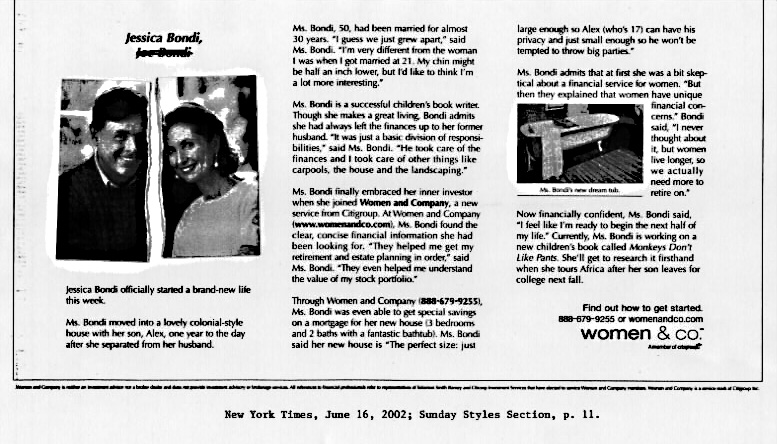
Normalizing divorce (cont.): Interesting news about the American Express ad (see below), but we must also add Citicorp and Salomon Smith Barney to the list of advertisers still employing divorce as a marketing tool. Their big ad in the June 16 New York Times -- on the wedding page, no less! -- features a photo of a charming, fifty-something couple that has been neatly ripped between their two smiling faces. Above the halved portrait are their names, "Jessica Bondi, Joe Bondi," with Joe's name scratched out. The first line of copy: "Jessica Bondi officially started a brand-new life this week." We learn that Jessica has left her husband and just moved into a beautiful new home with her 17 year old son, Alex, after almost 30 years of marriage. The reason for the split? "I guess we just grew apart," says Jessica.
Yet, despite being a "successful children's book author" Jessica always left the finances to her husband. This is where "Women and Company," a new venture formed by Citicorp and Salomon Smith Barney, steps in to help with financial advice, even helping Jessica to secure a low interest mortgage for her new house, which, by the way, has a "fantastic bathtub," a picture of which is also featured in the ad.
Welcome to the conventional advertiser's story of divorce. Divorce is the beginning of an exciting new life."Growing apart" is a valid reason to get divorced. Divorcing mothers are heroines, but they also need the help of certain companies (like us) who still care. Kids like Alex do fine with divorce when they reach some magical age near 18.
No mention in the ad of how Alex will feel about being reduced to the role of visitor in his father's new apartment, or watching his mother get dressed for dates with men he's never met. Or how Alex will feel on his own wedding day, when he'll probably spend more time worrying whether his parents will get along than enjoying the wedding. Or how Alex will feel any time that he looks at that picture from his childhood, the one with his parents beaming on either side of him, but sees only the jagged edges ripped between them. Posted by Elizabeth Marquardt, 6/17/02 | Link. Bill Doherty tells Diane Sollee about an American Express ad in the Toronto airport featuring photos of a couple having a great time, with this line: "Go where the quaint local souvenirs include radically improved marriages." Doherty writes: "Seems like we have moved some distance from the Levi's ad that said marriages end but Levi's jeans go on forever. Marketers are astute observers of the culture." Posted by David Blankenhorn, 6/14/02 | Link. A study finds that having children (especially male children) causes men to work harder and earn more. Posted by David Blankenhorn, 6/12/02 | Link. | | A married man writes to the Salon advice columnist: "I want to divorce my wife, but she just got pregnant. Should I still move on or stay for the baby's sake?" Cary Tennis, the advice columnist, advises: "What seems to harm children is not the lack of two parents per se, but the chaos, uncertainty, violence, neglect, and anger that often accompany unstable households. It sounds as though you have thought this through very carefully, and that's admirable."
Remarkable. Tennis generously assumes that the letter writer and his wife are living in pure hell, rather than the statistically more likely scenario, which is that he has gotten bored with the marriage and would like, as he puts it, to "move on." Then, in a bad imitation of bad social science, Tennis suggests that two parents "per se" are not so important for children, and that this guy's current marriage is more "unstable" for the child than whatever would come next if the guy were to leave. What powers of prediction! Finally, the guy is actually congratulated for having "thought this through very carefully."
If you are incapable of moral discernment, you may be suited to become an advice columnist for Salon. Posted by Elizabeth Marquardt, 6/12/02 | Link. | | "Family Values" (cont.): Responding to my view (below) of Robert Reich's use of the term "family values," a reader sent in some examples showing that "there are still plenty of people on the right who use the term approvingly." Good point. I should have qualified my claim more carefully. But I still believe that the term is used less and less by those who would use it approvingly, and is kept in circulation today primarily by those who use it to disparage others. Posted by David Blankenhorn, 6/10/02 | Link. The headline about a study published in the May issue of the Journal of Marriage and the Family reports, "Children's Psychological Well-Being Improves After Divorce, But Test Scores Do Not." The researchers looked at adolescents at four time points: three years and one year before the parents' divorce, and one year and three years afterwards. The adolescents were on average of 16 years old at the time of their parents' divorce.
The researchers make the case that psychological well-being improves because those whose parents divorced already showed psychological distress three years before the divorce, and by three years after the divorce their measured distress was smaller, thereby indicating a "recovery" in their psychological well-being.
This is a complex argument, far oversimplified in the headline. First, the psychological well-being of 10,000 study participants was determined by testing their self-esteem and how much control they felt they had over their lives. These are important areas to examine, but surely not wholly determinative of a person's psychological well-being. More critically, as I wrote recently in a Washington Post Outlook op-ed, and as others of my colleagues have argued, large scale studies that rely on questionnaires, videotaped interviews, and other "objective" assessments can only tell part of the story. Some young people may score favorably on such assessments, yet when a caring person talks to them about their lives, they often tell complex and painful stories of how their parents' divorce has shaped their lives. Are these young people lying? Or can objective assessments only tell part of the story?
Another reality of divorce is that children don't experience it at one point of their lives, but instead as a process that continues to unfold throughout their life cycles. The researchers measured how adolescents fared around the time of their parents' divorce. But they did not measure how they fare when they leave home, when they face another crisis in the family, when they start their own families, when one or both of their parents die, etc. I and others have seen that, at each life stage, the losses of divorce recur as children and young people confront new losses or joys with a fractured family system.
Finally, though we might acknowledge that this study tells us something -- perhaps part of a story -- about how adolescents roughly 16 years old fare around the time of their parents' divorce, it tells us nothing about young children. Would a five-year old and a nine-year old and a sixteen-year old all react to their parents' divorces in the same way? Of course not. In all cases divorce is a major loss, but it occurs at fundamentally different stages of their development. To say, based on this study, that "children's psychological well-being improves after divorce" is grossly inaccurate. Posted by Elizabeth Marquardt, 6/06/02 | Link. Our recent report, Hooking Up, Hanging Out, and Hoping for Mr. Right: College Women on Dating and Mating Today, examines the "hook up culture" on college campuses, in which fleeting, alcohol-fueled physical encounters, with no expectation that anything will follow from it, are considered normative for romantic relationships between college women and men. In the study, we also find that 83 percent of college women say that marriage is a very important goal, and that 63 percent would like to meet their future husband at college. But how, we ask in the report, can young women today possibly meet marriageable guys when the hook up culture reigns on campus?
Since our report came out, people have asked me if the hook up culture continues after college. Judging by The Hamptons, the first half of which was broadcast Sunday night on ABC, the answer is a clear, if unscientific, yes. This documentary of social life in one of the east's elite resort areas features twenty- and thirty-something women and men shacking up -- twenty-five people to a house, drinking themselves silly, flirting in hot tubs, and generally reliving their college days with a vengeance, right down to the way they conduct relationships. One young woman, an attorney in her late twenties, is featured at the beginning of the film saying that she's determined to find a husband this summer. For the rest of the film we get to watch her throwing herself all over a number of mildly interested, but rather drunk, men. Yet, when the guys are off alone, gathered around the keg, what are they saying? "I'm not looking for anything serious," one says. "I've got years for that. I'm just looking for someone to hook up with. I'm looking for something that lasts a minute and a half." Women have made many gains in the last several decades, but an irony has arisen. Most women still want marriage, and they'd like it to happen before they are too old to have babies. Yet they look for marriage in a culture that supports hook ups but not commitment -- a culture that conforms rather nicely to the adolescent desires of many young men. In the old days, the elders would have told these young men to straighten up, treat women with respect, and prepare for a career in which good salaries help to support families, not the acquisitions of expensive toys. But in The Hamptons, the older folk stand around lavishing praise on these giggly, playboy young men, while the young women who talk of marriage are presented as rather quaint, if not pathetic. Posted by Elizabeth Marquardt, 06/06/02 | Link. For an entire chapter in his new book, I'll Be Short, Robert Reich lambastes those in the U.S. who march under the banner of "family values." These "family values" advocates are hypocrites, he charges. Hypocrites and much worse. They are haters, accusers, dividers, "prophets of doom." Their real agenda is to punish single parents, gay people, working women, poor people, and anyone else who doesn't fit their "Ozzie and Harriet model." These "family values" spokespeople are sexist, they favor the rich, they turn a blind eye to corporate abuses, and so on. Pretty scary stuff.
Yet Reich fails to offer a single concrete example of this allegedly widespread "family values" phenomenon. Not the name of even one person who espouses any of these positions in the name of "family values," not a single hateful-sounding quote in favor of "family values," not a single book or article or speech or event or action that defines the "family values" orientation that Reich is so effusively denouncing.
Perhaps Reich was too busy, or too confident of his basic thesis, even to try to track down an illustration. But were he to try, I think he would have a difficult time, in part because his accusations are expressed with such hyperbole, but also in part because no one uses the term "family values" anymore, except in the way that Reich is using it -- that is, as a term of abuse to hurl at unspecified political opponents. Perhaps I've missed a few specific occurrences, but basically, as far as I can tell, people who publicly worry about the weakening of marriage and family life in the U.S. stopped using the term "family values," if they ever did, about a decade ago, about the time that then-President Bush trotted it out for a brief moment during his failed re-election drive, and when, in response, candidate Bill Clinton ridiculed the phrase quite effectively on the stump. (Remember? -- "Family values means a government that values families!")
All of this was a long time ago. Since then, concern for strengthening the family has become, in political terms, almost completely bipartisan. Occasionally, the term "family values" still pops up in commercial advertising slogans aiming for a bit of humor and irony, as in "These hot dogs are real family values!" But today's flesh-and-blood marriage and family advocates say it about as often as people shopping for cars say "Edsel." The only people regularly using those words today are people like Robert Reich, who are looking for a bludgeon. Okay, you want an illustration? Read the ever-thoughtful Judith Stacey's article in The Nation, "Family Values Forever."
Personal confession: I've always intensely disliked the term, since it reeks of politics, and I've always believed that it's misguided to construe the family issue as an issue of partisan politics. Posted by David Blankenhorn, 6/03/02 | Link.
An article in the New York Times reports that a number of recent celebrity weddings featured in the magazines InStyle and InStyle Weddings ended divorce after the issues in which the stories appeared had gone to press, but before they reached newsstands and subscribers. What an embarrassment...for the magazines. Posted by David Blankenhorn, 6/03/02 | Link.
Normalizing divorce: My daughter was watching a cartoon show on Nickelodeon about a girl named Ginger. I noticed that Ginger's mom was a character in the show, but I didn't see the father. "Where is Ginger's daddy?" I asked. "He moved out," answered my six-year-old, in a completely matter-of-fact way.
Later, I looked up the episode guide on the show's web page. The first we learn of Ginger's father -- the web page says that "he's been a bit unreliable in the past, but he's a pretty good guy!"-- is in an episode called "Hello Stranger," which is also the name of the poem about her dad that Ginger wants to read at a school show. Posted by David Blankenhorn, 6/03/02 | Link.
|
|
|